December 31, 2015

2015 - Dow and S&P 500 lose, Nasdaq gain

So another year in the books.  2015 was the first year since 2008 that the DJIA lost value.  S&P500 too but the Nasdaq gained so where do you stand?

Dow down 2.2%
S& P 500 down 0.7%
Nasdaq up 5.7%

Have you heard from your financial guy lately?
Same ol' same ol', we are in a stock pickers market, expect volatility, blah, blah, blah.

If it was a stock pickers market, should I assume your financial guy beat the market?

More than likely, he fared worse than the market and do you know why?

Two reasons.

1) he basically buys the market (something you can do yourself)
2) he charges a fee (takes money out of your account)

Learn more here.

September 30, 2015

Down 7% In One Quarter, What Is Your Financial Guys Strategy, If Any?

What exactly are you paying for?
Why do you have a financial guy?
When the market is down 7% in one quarter, what is the strategy?
These are all good questions for you to ask yourself and your financial guy.

Remember that financial guys get paid by taking money out of your account, either by fees or by commissions.  That is the job, period.  Make no mistake and it takes more clients to make more money which is why you don't hear from him very often if at all.

What are you doing to yourself?

http://www.cnbc.com/2015/09/30/whats-next-for-stocks-after-worst-quarter-in-four-years.html


August 21, 2015

Dow Off 500, How Many Financial Guys Have Seen This?

So with the DJIA off more than 500 points today and the correction firmly in place.  The biggest question I have is how many financial 'advisors' are new to the business in the last 7 years and what are they likely to do with their clients money?

USA Today Article - http://www.usatoday.com/story/money/markets/2015/08/21/asian-markets-tumble-wake-us-sell-off/32100683/

The financial is like most industries, they seem to have very bad timing.  They have been hiring new financial advisors at a pace not seen since (you guessed it) 2005.

Now that the DJIA is firmly in correction territory, down 10%, the analysts and Wall Street crowd will all be pointing fingers.  You will be hearing stuff like volatility, correction, bear market and why they think its going lower or higher, what you won't hear is who told you to sell at Dow 18000 because no one did!

Just Sayin'.

June 8, 2015

Calpers doing what you should - lower your fees!

Bottom line is that fees are everything.

The investment business is built on the fallacy that they can invest better than you can.

Not only that, they will charge you a fortune to invest your money regardless if they beat the indexes or not.  WOW.

Finally, the country's largest pension fund, Calpers sees the light.  Read the NY Times article here.

April 21, 2015

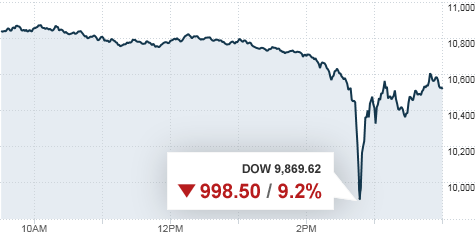
Flash Crash in 2010 was a buying opportunity

So today one guy, one trader was charged with causing the flash crash in 2010.  That one guy can cause that kind of damage is amazing. See http://www.cnbc.com/id/102573733.

chart_dow_dip2.top.gifBottom line though, is that the DJIA was approximately 10000 that crazy day and if you panicked, you sold at a terrible time, the DJIA in now approximately 18000.

I was very young in the market in 1987 when the market plunged 22% in one day and truly thought the world was over.  But as I learned over the years, again, if you panicked and sold, you look pretty silly right now, the DJIA was 1800 then.  Link here, see http://en.wikipedia.org/wiki/Black_Monday_(1987).  The DJIA has risen 10x since then!

The point is that traders may care alot about intraday moves and that is unfortunately who you see on the news so it is natural to get likewise scared but learn from these moves that they are temporary and in most cases, awesome buying opportunities for long term buy and hold investors.

Remember, passive investing beats active investing.  Don't get rattled by intraday and short term moves.  Buy quality and let others sweat it out.


March 3, 2015

Index Investing versus Hedge Funds (and it's not even close!)

Warren Buffett has a message for public pensions, colleges and the like: Stop pouring money into expensive, high-end money managers.
"The commission of the investment sins listed above is not limited to 'the little guy.' Huge institutional investors, viewed as a group, have long underperformed the unsophisticated index-fund investor who simply sits tight for decades," Buffett wrote in his latest letter toBerkshire Hathaway shareholders.
Buffett has long been a critic of so-called alternative investing, a category that includes hedge and private equity funds, among others. The reason is the cut they take for their services, which can make billions of dollars for the managers but far less for clients, according to the man sometimes called "The Oracle of Omaha."
"A major reason has been fees: Many institutions pay substantial sums to consultants who, in turn, recommend high-fee managers. And that is a fool's game," Buffett wrote on underperformance.
Institutional investors include pension funds, university endowments, foundations and sovereign wealth funds managed on behalf of countries.
Buffett already has his money where his mouth is. His famous "Million-Dollar Bet" with hedge fund-focused investment firm Protégé Partners is that a simple S&P 500 index fund managed by Vanguard would beat a mix of five funds of hedge funds over 10 years.
Through seven years, Buffett's index fund is up 63.5 percent while the five funds of funds selected by Protégé are up an estimated average of 19.6 percent, according to a Fortune report in February.
Buffett's renewed criticism comes as institutions are giving record amounts to alternative investment managers. Many view such funds as a way to limit risk and volatility in various asset classes, such as stocks and bonds. 
Consultants and institutions argue that the distinguishing factor is picking the right managers. Buffett acknowledged that some do outperform, but said selecting them is too difficult.
"There are a few investment managers, of course, who are very good—though in the short run, it's difficult to determine whether a great record is due to luck or talent," Buffett wrote. "Most advisors, however, are far better at generating high fees than they are at generating high returns. In truth, their core competence is salesmanship."
Alternative funds have long argued they do add value, especially if the goal is to help generate steady returns in the mid-single digits—performance that is designed not to beat the stock market in many years.
"Hedge funds help institutions provide retirement security for millions of workers and their families, scholarships and research funding for universities, and resources for grants and other philanthropic work to benefit communities across the nation," the Managed Funds Association wrote in its most recent annual report.
The average hedge fund return over the last 10 years was 5.67 percent net of fees, according to the HedgeFund Intelligence Global Index, which tracks funds across strategies. That compares to an annualized return of 7.65 percent for the S&P 500 index over the same period. (Many hedge fund strategies don't focus on stocks, making such simple comparisons misleading, according to industry proponents.)
The private equity industry also likes to tout its high returns: a PE benchmark average gain over the last 10 years ended June 30, 2014, is 14.3 percent net of fees, compared to 7.8 percent for the S&P 500, according to the Private Equity Growth Capital Council.
"Private equity has experienced strong investment volume because, year after year, it generates superior returns for institutional investors," a PEGCC spokesman said in an email in response to Buffett's comments.
THIS ARTICLE CAME FROM CNBC, see it here.

February 18, 2015

Retirement Rules for Financial Advisors and Brokers May Tighten

This article from the WSJ.  It is about time that brokers should have to put their clients interest first.  I'm amazed that it hasn't always been a requirement!?

Retirement-Account Standards May Tighten
Brokers Would Have to Put Clients’ Interests First


WASHINGTON—Brokers who recommend retirement-account investments would have to put their clients’ interests ahead of personal gain under rules expected to be endorsed by the Obama administration as soon as next week.
At present, the brokers’ recommendations for 401(k) plans and other retirement accounts generally have to be “suitable,” a weaker standard that critics say permits high fees that eat into investors’ returns.
A White House announcement of the so-called fiduciary rules is expected to generate significant pushback from Wall Street, which says it already faces robust regulation and warns the rules’ likely costs could make it uneconomical for brokers to serve lower-balance accounts. It likely would take several additional months for the Labor Department, which is drafting the rules, to collect public feedback before it can move to implement the rules.
The administration is concerned investors aren’t aware that brokers benefit financially by selling products that may not be in a client’s best interest but still rise to the lower standard of being suitable investments.
“The current regulatory environment creates perverse incentives that ultimately cost savers billions of dollars a year,” Jason Furman, chairman of the White House Council of Economic Advisers and CEA member Betsey Stevenson, wrote in an internal memo last month.
The White House memo argues that investors lose as much as $17 billion annually in retirement dollars—or “at least” 5% to 10% of their retirement savings over 30 years—because of “excessive fees” and “conflicted” advice—amounts disputed by the industry.
“We think the data and studies are less than conclusive and in many cases dated,” said Kenneth Bentsen, president and chief executive of the Securities Industry and Financial Markets Association. “It’s designed to cast aspersions on the broker model,” he added.
The potential for so-called fiduciary rules has triggered debate over the past five years, pitting brokerage firms against investor advocates over the way in which retirement accounts are sold to investors.
The standards, if finalized, could end up cutting into payments brokers and others collect from mutual-fund and insurance companies when they sell plans to retiree clients. Brokers have pushed back against stricter rules, warning they will drive up costs and reduce retirement choices.
The rules are expected to be more flexible than a 2010 proposal the Labor Department withdrew amid an outcry from Wall Street, which complained it would have barred many routine payments to brokers, including commissions.
They won’t bar commissions for those who sell retirement investments but would ensure brokers and other financial professionals have an overriding responsibility to keep their clients’ best interests when giving financial advice.
The proposal is expected to address what critics view as loopholes in existing law that allow brokers to skirt a fiduciary duty, such as when they only provide one-time, as opposed to ongoing, advice or by saying their recommendations weren’t the basis of an investor’s decision to buy an investment product. The proposal is also expected to tighten fiduciary rules to advice provided to individuals looking to roll over 401(k)s into individual retirement accounts when they leave a job or retire.
Industry groups and some lawmakers have urged the Labor Department to wait until the Securities and Exchange Commission decides on its own definition of a fiduciary standard for investment advisers and brokers working with mom-and-pop retail investors. The SEC, under the 2010 Dodd-Frank law, gained authority to write such standards but isn’t required to do so. The agency’s efforts apply broadly to advice about securities like stocks and mutual funds but not to workplace retirement plans.
The SEC has consulted with the Labor Department on the rules, and SEC Chairman Mary Jo White and Labor Secretary Tom Perez have met at least twice to discuss the department’s proposal, according to people familiar with the matter.
Labor Department officials declined to spell out details of the proposal. But the measure is expected to soon advance to the White House Office of Management and Budget for review, after which it would be subject to public comment.
—Byron Tau contributed to this article.

January 18, 2015

Some Financial Guys, Stockbrokers and Advisors do provide value

For those that follow this blog, you know that I beat up and bruise financial guys often.  Most are not worth your time and certainly not worth managing your hard earned money - BUT NOT ALL.

Some financial guys do provide value!  Yes, I have repeatedly said that paying 1% (which is alot of money over time) is not worth it when you can probably do as good or a better job yourself.

But there are circumstances and certain financial guys that ARE worth the fees you pay.

Let me explain.

If you use a financial guy and all he/she does is buy you mutual funds or etf's or so many stocks that it's like owning the entire market then you are wasting your money.

The guys that provide value do something different and act more like a consultant than a salesman!  I'm not talking about taking you to lunch or golfing, that's what salesman do.  The guys that provide value might sell calls against your stocks.  They go to cash occasionally.  They call you with a great income idea (something you didn't read in the WSJ).  They have a great tax saving idea.  You get the point.

So next time I beat up on your financial guy, and I will, remember, I don't mean ALL.

December 31, 2014

Ask Your Financial Guy Why Your Money Didn't Grow at 11% in 2014!

2014 is in the books.  How did your portfolio do compared to the indexes?  All three major indexes did pretty well and probably did too (if you didn't sell during one of the three major pullbacks).
These numbers do not include dividends.

DJIA 7.5%.
S&P 500 11.4%.
Nasdaq 13.4%.

I've said it a thousand times.  If you use a financial guy for advice, that's fine but do not expect to beat or even match the averages.  This is simply because he or she has to get paid.  And guess what, that is you.  Every quarter, your financial advisor takes money out of your account as a fee or your stockbroker takes commissions every transaction.  Either way, there is no free lunch and those fees and or commissions cut into your returns, period.

Now is the time to look at your statement to see how you did.  Let me know.

December 1, 2014

Santa Claus Rally?

The Santa Claus rally seems more like a gamble than an investment strategy.  Please read USA Today article and note that 94% of fund managers are trailing the simple S&P 500 index!
http://www.usatoday.com/story/money/markets/2014/11/30/dec-market-report-santa-claus-rally/70098600/

October 15, 2014

Update To Sell In May and Go Away

In April of this year, I blogged about the old Wall Street axiom, sell in May and go away.  There is a theory that if you sell in May and buy back in October that your investment returns will be better than just buying and holding.

Of course, you will miss out on a few dividend payments which as I've said before and hundreds of experts agree is at least half of the market returns over time but aside that, selling in May does seem to have some merit occasionally. 

There are exceptions to the rule and unfortunately, far too many to ignore so the answer if you should sell your stocks in May and buy back in October is not easy.  It is up to you.

In this year 2014, the market had run up for five years so taking some money off the table may not have been a bad idea BUT the problem with that is that you have to buy back in someday and invariably individual investors are not good market timers (neither are Wall St pros).

Sorry not to have a crystal ball.

October 10, 2014

CNBC Traders Results


I've been interested to see the results of the traders who have been 'paper' trading with $100,000.  To no ones surprise, certainly not mine, some have beaten the market slightly and most have trailed.

These are celebrated people on TV who manage peoples money for a living (besides being on TV).

You can see current results here at CNBC.  Feel free to compare these to the results of the S&P 500 or the DJIA.

I don't mean to rag on anyone in particular but as I have said on this blog and hundreds of times on radio or in articles - IT IS VERY HARD TO BEAT THE MARKET with any regularity at all.  The 'traders' on CNBC can't do it, most mutual fund managers can't do it and certainly, your local financial advisor can't either.

Bottom line is that like most people involved in the investment business, they are in the business of making money - for themselves.  This is achieved by separating you from your money via commissions and fees.

Check out my blog post from 2011 where I compared money management and gambling.


April 28, 2014

Sell In May Go Away, Does It Work?


One of the oldest sayings on Wall Street is 'sell in May and go away'.  What it means is that investors are supposed to sell their holdings sometime in May, go to cash and reinvest sometime in late September. You can see already some of the folly, which day to sell? which day to invest?
Anyway, you can see from the chart below that it does appear to pay off to be 'long' from October to April as opposed to May to September.                                                                 
cotd sell in may

March 7, 2014

Five Year Anniversary Of The Bull Market

The US bull market is now 5 years old.  That is a long time.  Probably few investors remember how terrible the markets where just five years ago.  There were people calling for the end of capitalism!  The old saying goes "buy when everyone else is fearful" couldn't be more true than it was March 9, 2009.

The current bull market may not be the longest in history but it is getting close.  You never know what will derail it, sometimes it is valuation, sometimes it is geopolitical and sometimes it takes just one small event to trigger selling.  I know this, with more hedge funds holding more assets, when real selling occurs, it will be swift.  You need to decide now what you might do.

My favorite of all wall street sayings is "professionals sell on the way up and amateurs wait for trouble and sell on the way down".  The psychology behind this is true.  I don't know when the bull market will end but check out the chart below and remember the terrible bear markets that took place after each!

If you utilize a financial guy, make sure you compare your brokerage account to history and if you didn't annualize over 19% a year over the last five years, then you are paying for nothing.

Don't expect your financial guy to sell anything now either for two reasons;
  • financial advisors only get paid for assets on the books, not cash
  • it's easier to be one of the crowd and ask for forgiveness when your account withers rather than risk being right
bull markets data


January 2, 2014

The Results Are In !!!

Followers of this blog know I have been following the results of the picks of a major brokerage firm for an entire year and the results are in.

JP Morgan gave us these picks via CNBC on the last day of 2012 so I posted the prices an investor would have got on the first trading day of 2013 and now the last day of 2013 and COMPARED them to a regular old boring index fund.  See the results below including the % gain for each.

Boeing (BA) - 76.93 136.49 77.4%
Bank of America (BAC) - 11.96 15.57 30.3%
Capital One (COF) - 60.05 76.61 27.6%
McDonalds (MCD) - 90.21 97.01 7.5%
Visa (V) - 155.71 222.68 43.0%
Apple (AAPL) - 547.76 561.11 2.4%
Ebay (EBAY) - 52.28 54.87 5.0%
Whole Foods (WFM) - 92.42 57.83 (after 2-1 split)(115.66) 25.1%
Starbucks - (SBUX) - 54.51 78.39 43.8%
Target (TGT) - 58.34 63.27 8.5%
2013 JP Morgan stock picks average 27.1% 

Vanguard Total Market (VTI) - 74.65 95.92 28.4%
Schwab Market (SCHB) - 35.04 45.01 28.4%

OK, so the average of the JP Morgan stock picks is 27.1% which is a pretty awesome year HOWEVER, the index funds averaged 28.4%.  These results do not include dividends or fees which both scenarios would include so would cancel each other out.  Additionally, you would likely pay a fixed fee of 1% to have someone 'manage' your money which would of course lower your results versus buying an index fund yourself.

The conclusion is easy.  Don't waste your valuable time and money using a stockbroker or financial advisor and paying a fee for under performance.  As I and others (Warren Buffett) have said repeated, it is extremely difficult to outperform an unmanaged index fund.

July 1, 2013

JP Morgan stock picks versus the market - 6 month update

OK, at the end of last year, JP Morgan gave us their stock picks for 2013.  I wanted to see how they'd stack up against the market.  Here are the results for the first six months of 2013.
I've been curious if the so called professionals were any better than the market in general.
I figured the fairest way to do this was to pretend to buy their stock picks on January2 during the day, an average price and then compare it to a few broad based ETF's (exchange traded funds).  The original article is here.

The closing prices for JP Morgan picks at the close of June28 below.
BA $102.44
BAC $12.86
COF $62.81
MCD $99.00
V $182.71
AAPL $396.53
EBAY $51.72
WFM $51.48 (after a 2-1 split)
SBUX $65.51
TGT $68.86

The closing prices for the ETF's are below.
VTI $82.70
SCHB $38.91

The bottom line is that the JP Morgan picks (without dividends) averaged a nice 9.3% gain.  That's pretty good and you'd probably pat your broker on the back, six months, not bad.  BUT WAIT.  If you bought the broad based ETF's, you'd have averaged 10.9% (without dividends).

Most likely you would have paid commission to your stockbroker or a flat fee to your financial advisor for those picks which would have lowered your returns.  To be fair, you would have paid a transaction fee to buy the ETF's as well but it would have been considerably less.

Once again, as I've always said, with all due respect, your stockbroker or financial advisor has proven here they provide little in the way of value to an investor and that you should have the person who cares the most about your money handling it - YOU !!!


April 30, 2013

Retirement Planning Is Useless

We all know the saying, rather be lucky than good.  Well, that saying is never more true than when looking at retirement.  As a former stockbroker / financial planner, I hate to admit it but a lot of retirement is luck.  Saving for retirement is extremely important BUT planning is not.  

You can easily see what I mean.  Imagine two people with basically the same incomes (adjusted for inflation) and one person retires in 1980 and parks the bulk of their retirement money in safe CD's paying 15%!  Now that is good timing but is really just plain luck, not planning.

Imagine a second guy who retired just a few years ago, in 2008, ouch, first off, he likely lost some of his retirement money in his 401k or IRA and then had the unfortunate timing to choose between a stock market that is pretty darn scary or a CD or other fixed income paying virtually nothing.  This is also luck, bad luck, but again, has nothing to do with planning.

The point is that while retirement planning is fine idea and looks good on paper, its really a useless exercise with little value.  Financial planning is propagated by the investerati to keep your assets under their control and is a multi-billion dollar industry based on nothing!

A better idea is to be fiscally prudent (buy what you can afford), save what you can when you can (set a goal of 10%-15%), don't stress too much about retirement and when it comes time to retire, then and only then can you truly plan.

Planning when retired (or within a year at most) is infinitely more accurate, you will know what assets you have, what liabilities you have and can adjust your lifestyle to match, its that simple.  In my book,  How The Investment Business REALLY Works, I offer a worksheet in the back of the book that will walk you through the simple steps to what I call Realistic Retirement but you can see a free version here.


February 28, 2013

You Need To Be Invested For Your Financial Guy To Get Paid

The way the brokerage business is set up now is not necessarily great for the individual investor.  

The reason is the way stockbrokers, financial advisors, etc get paid.  Unfortunately, the way it works now is that your financial guy gets paid in two ways;
  • buying and selling in your account (commissions)
  • as a percentage of your total assets (fees)
Neither is good for you, let me explain.

If you go the commission route, to be sure, there is a conflict of interest.  You can never be sure that when you get a call to buy or sell or move investments that it's in your best interest!

If you go the fee route (which is increasingly common), then your financial guy gets paid a percentage (usually 1-2%) of your invested assets.  That is a huge problem which is very under reported.  Bottom line is that your money has to be invested for him to collect a fee.  Do you think he'll ever call you to say its time to be conservative and go to cash?

So if you have ever wondered why you don't get a call to go to cash when times are tough, 2007 for example, now you know.  It is simply not in your financial guys best interest for you to be in cash!

January 2, 2013

JP Morgan Individual Stock Picks Versus The Market

Watching CNBC on the last trading day of 2012 and they showed JP Morgan 2013 stock picks.  I couldn't help but think that this list looks alot like buying the entire market so here are their picks along with prices the morning of 1/2/2013.  So often we see analyst individual stocks picks before the market opens when a stock reported great news.  This creates a fake price which no one could have got so here are the real prices after the market opened as if you were buying them and compared with a few market based ETF's.
Boeing (BA) - 76.93
Bank of America (BAC) - 11.96
Capital One (COF) - 60.05
McDonalds (MCD) - 90.21
Visa (V) - 155.71
Apple (AAPL) - 547.76
Ebay (EBAY) - 52.28
Whole Foods (WFM) - 92.42
Starbucks - (SBUX) - 54.51
Target (TGT) - 58.34
Vanguard Total Market (VTI) - 74.65
Schwab Market (SCHB) - 35.04

I've said it before and I'll say it again, you can do many things to increase your ability to invest well but #1 is to invest on your own.  Keep up with this post, I will monitor and provide updates below.

December 31, 2012

2013 Prognostications Are Useless

OK, this is the time of the year to both look back and look forward.  I love the 'best of' lists that look back.  I hate the prognostications that look forward.  Maybe it's because there is no accountability.

You will see every brokerage firm and finance guy with an eye to 2013 giving you his/her best ideas or best stock picks for the upcoming year.  Have you ever seen a recap of how that guy/gal did over the previous year?  NO.  And you won't.

I get it, it's fun.  Just don't take it seriously and do not change your investment plan because of it.  Alot of times these predictions are made so you will change investments around which create commissions, get it?

I write an investing newsletter called the INVESTING OPINION and yes, I make predictions too but I am accountable and I compare myself with the market averages all the time so you can see how I rate.  I'll bet your stockbroker or financial advisor cannot say the same!

Do yourself a favor and check your account versus the S&P 500 or the Dow Jones and see if what you are paying for is worth it.  Just sayin'.